
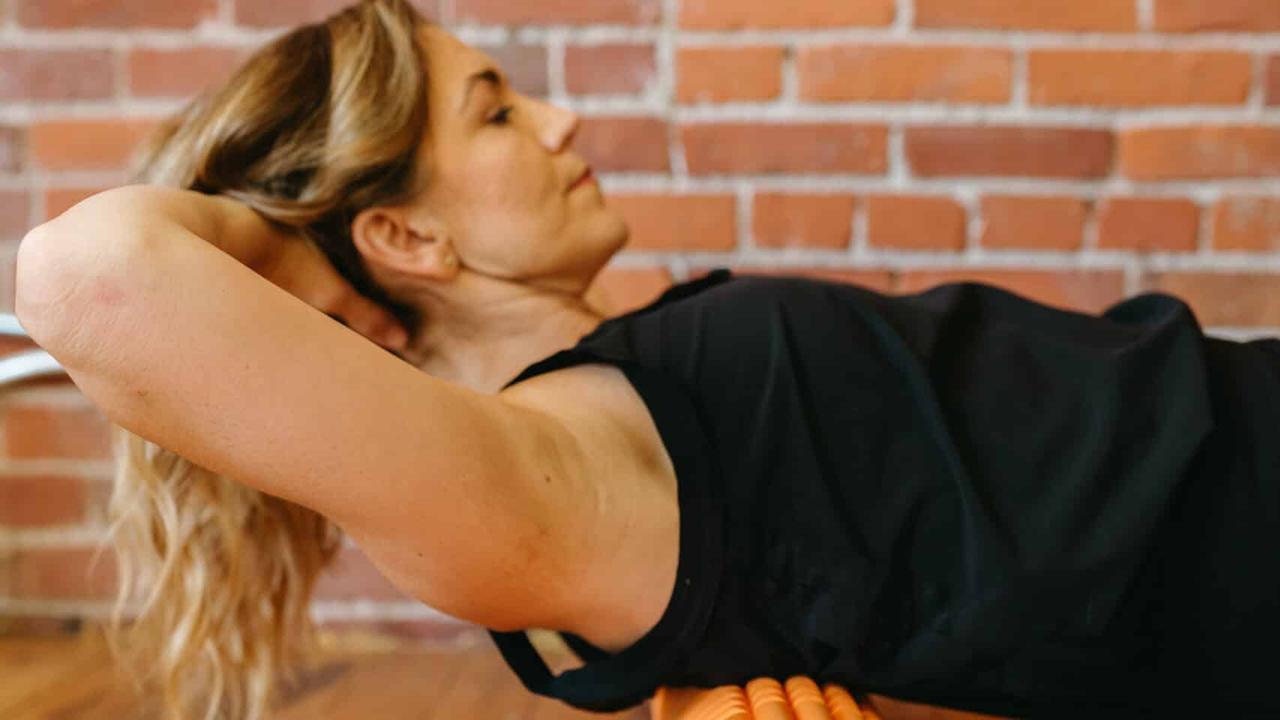
Self-Myofascial Release (MFR): What It Is and Why You May Need It
A simple, restoring practice for better recovery, mobility, and body awareness

Self-Myofascial Release (MFR): What It Is and Why You May Need It
A simple, restorative practice for better recovery, mobility, and body awareness
Let's talk about self-myofascial release, or MFR.
Over the past year and a half, I've woven MFR into my private yoga and personal training sessions, and I've seen outstanding results over time — for my clients, my students, and myself.
So why do people roll around on foam rollers and lie on tennis balls? This post will bring some clarity — and bust one persistent myth along the way: MFR is not meant to be self-torture. Done well, it's quite the opposite.

First, what's fascia?
Let's start with a quick overview of the fascial system.
Fascia is connective tissue found throughout the body. It comes in layers and covers and connects nearly everything inside of us. It's a communication system — highly innervated, with more nerve endings than almost anywhere except the skin — and it gives the body structure. Remarkably, fascia is incredibly strong, and yet it can adapt and change shape depending on the demands placed on it.
It's an intelligent system. It distributes tension throughout the body, and its overall health is key to musculoskeletal injury prevention. (Want to go deeper? Start with the work of leading fascia researcher Dr. Robert Schleip.)
So what is MFR?
Myofascial release — or self-myofascial release — is a form of self-administered manual therapy. (Manual therapy is the hands-on work that physical therapists and massage therapists do; with MFR, you're learning to do a version of it for yourself.)
Using various tools, MFR applies a low-load, long-duration stretch to the myofascial complex, with the goal of restoring optimal tissue length, decreasing pain, and improving function. All that foam rolling and tennis-ball work you've seen? That's this.
Why I focus on it
The top reasons I emphasize fascial health in both yoga and exercise are the increase in body awareness it builds and the parasympathetic ("rest and digest") tone it can put us into almost immediately. Beyond helping to release adhesions in the fascial layers and improve joint range of motion, MFR is outstanding for recovery and self-awareness.
In practice, MFR promotes tissue hydration, induces the body's parasympathetic response (rest mode), helps with trigger points (those tender, tense spots), and supports a balanced body that moves efficiently. It also feels great, requires no fancy equipment, and doesn't take much time. What's not to love?
The tools (you may have most of them already)
You don't need anything expensive — but using some kind of tool does matter. Options include MFR balls, yoga blocks, a foam roller, tennis or lacrosse balls, MFR sticks and rollers, recovery rounds, even a yoga bolster, a rolled blanket, or pillows.
Be resourceful and use what you've got. You can work against the corner of a wall (go easy), or even use your own body — lying on the floor and gently rocking your hips back and forth is a form of release too.
One important reminder: the props are there to help you relax, not to send your body into stress. There's no benefit to aggressively "digging in" to "break up" fascia or adhesions. That's not how it works — and that's the myth worth letting go of. You also don't need crazy bumpy rollers or aggressive pressure. This isn't torture.
Three Foundational Techniques
There are many MFR techniques, but these three are the foundation.

Compression is my favorite go-to technique for self-study, building awareness, and investigation. It's good for trigger points and for inducing that parasympathetic rest response — discovering where tension lives and then witnessing the body let it go. To do it, position your body weight onto the ball or prop and rest there, still, for about 20–60 seconds. Stay comfortable; you're not trying to irritate the tissue. Sometimes a little rolling first helps you locate the tension, and then you settle into compression.

Rolling means moving with the tissue to bring in hydration — almost like gently combing the tissue by going slowly. It's good for investigation (finding areas of tension), circulation, hydration, and lymphatic and venous return, where we "rinse and flush" out byproducts and stimulate the immune response. Roll slowly up and down over a ball or foam roller with small movements, only traveling a few inches at a time, going with the direction of the muscle fibers.

Cross-fiber uses your tool across or perpendicular to the muscle fibers, which helps break down adhesions and brings hydration. It's good for going a little deeper and more specifically into the fascial layers, and for stimulating fibroblasts to lay down orderly collagen. Rock your body gently side to side over the tool, against the direction of the fibers — and it's nice to finish with a moment of stillness in compression.
How to actually do it well
A few guiding principles matter more than any single technique. Approach MFR as self-study: sit with it, pay attention, even enjoy it. There's no pain and no attacking — you're not chasing soreness, because more isn't more. If something hurts, reposition until it doesn't, supporting your body weight or covering a firm tool with a blanket to soften it.
The whole point is calm. When you guide your nervous system into a relaxed, resting state, your tissues follow. Stay curious and investigative as you learn to read your body's signals. You shouldn't be sore for days afterward — if you are, back off next time. Aim for roughly 30–60 seconds per muscle group, and if you're not sure where to begin, I always recommend starting with the glutes and the feet.
One more thing: ask your doctor first. Anyone who isn't cleared to receive a massage shouldn't be doing MFR.
Let's work together
As you can tell, I'm a fan. MFR supports balance, recovery, stress reduction, body awareness, and overall wellbeing — and it's inexpensive and time-efficient to boot.
If you're managing a specific condition like osteoarthritis, I go deeper on how MFR can help in my post on osteoarthritis and self-myofascial release.
Have questions about any of this? Reach out anytime. Better yet, let's do a private session where you can learn these techniques and make them your own for years to come. I offer virtual 1:1 private therapeutic yoga and personal training. Book a session.