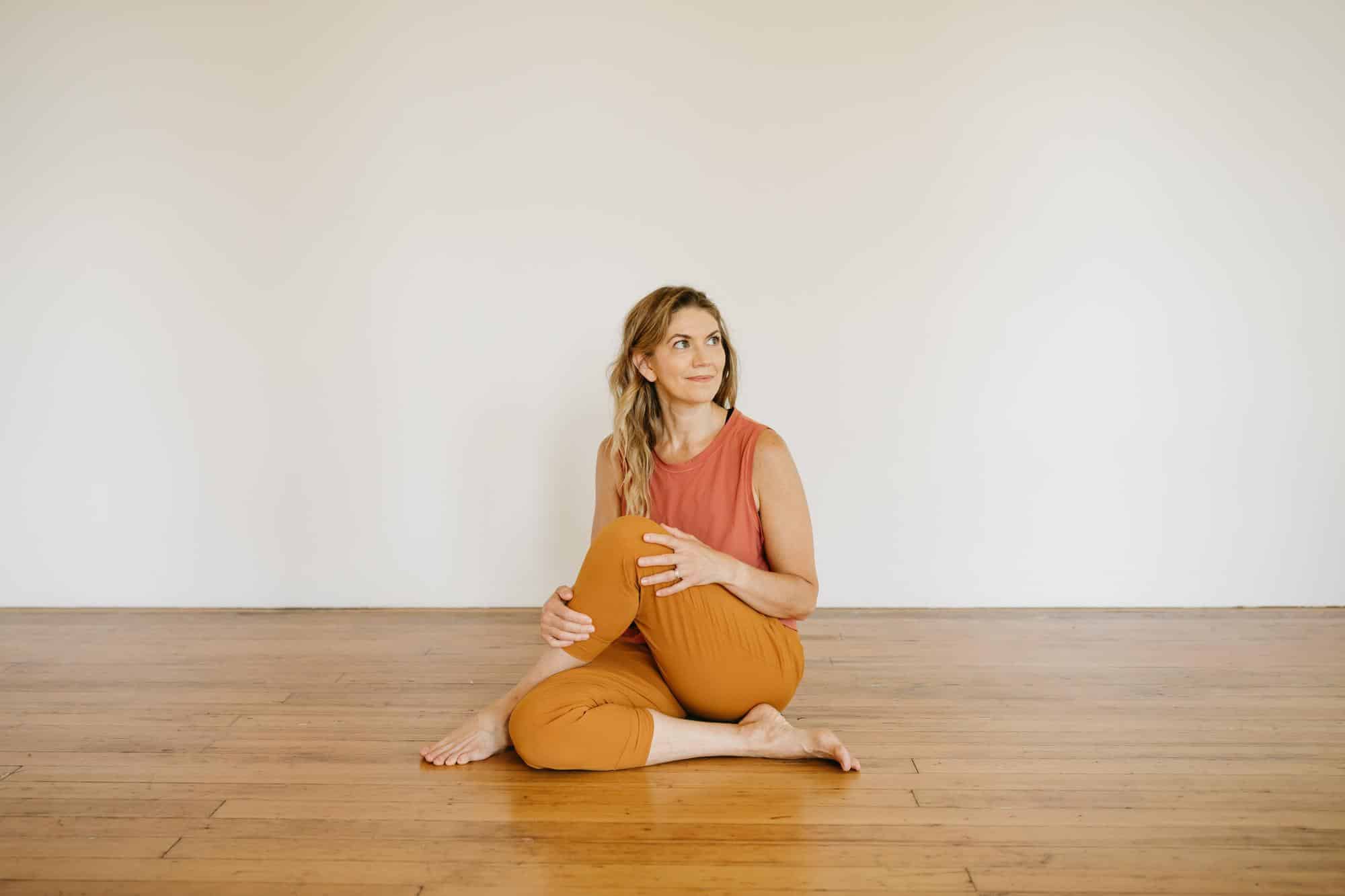
Where You Look Is Where You Go
How finding a steady gaze — on the mat and in life — can calm the chaos and bring you back to now
Balance, equanimity, steadiness — these words come up a lot in yoga. But outside the classroom, balance isn't a controlled experiment. It's inside rush hour and hard conversations and joy arriving at the same moment as grief. It's your focus unraveling, thoughts scattering, emotions swinging from one extreme to the other before you've had your second cup of coffee.
So how do you find evenness in the middle of all that?
In yoga, the answer often starts with something surprisingly simple: where are you looking?
The steady gaze
A focal point — a drishti in yoga terms — is more than a trick for not toppling over in tree pose. When you find a steady point to rest your gaze, something in the brain actually settles. The nervous system gets a quiet signal that things are okay. Awareness sharpens. The noise doesn't disappear, but it softens enough that you can see what actually needs your attention right now.
This works off the mat too. When life feels most chaotic — when you've lost the thread of what matters, when you're being pulled in too many directions at once — the question worth asking is: where am I actually looking? What am I focused on? Is my attention resting on something steady, or am I scanning the room for everything that could go wrong?
Balance wants to include you in this very moment. But it asks something in return: a willingness to look directly at what's in front of you, rather than everywhere else at once.
Leaning into the unknown
Here's where it gets interesting — and a little terrifying, in the best way.
When you attempt something entirely new, whether it's an arm balance or a major life shift, the gaze becomes even more important. Because the temptation, when something feels unstable, is to look away. To brace, to overthink, to scan for the exit. But that's usually exactly when you fall.
Take crow pose — a classic yoga arm balance where you're essentially launching yourself off the ground using only your hands and your nerve. It looks intimidating. It occasionally ends in a faceplant.
But the moments just before you find it are instructive: when the gaze drifts, you wobble. When you fix your eyes on a steady point ahead and let the breath stay smooth, something clicks. You discover a capacity you didn't know you had. You learn something about yourself that no amount of thinking could have told you.
That's what balance offers, in yoga and in life — not a guarantee of stability, but a chance to find out what you're capable of when you stop looking away and actually show up for the attempt.
Where to look
So when things feel uneven — when the chaos is loud and the ground feels uncertain — start with your gaze. Find one steady point, externally or internally, and rest your attention there. Let the breath follow. Not as a way of ignoring the difficulty, but as a way of meeting it clearly.
Balance isn't about eliminating the wobble. It's about finding the still point inside it — and having the courage to keep your eyes open while you do.